 Español
 English
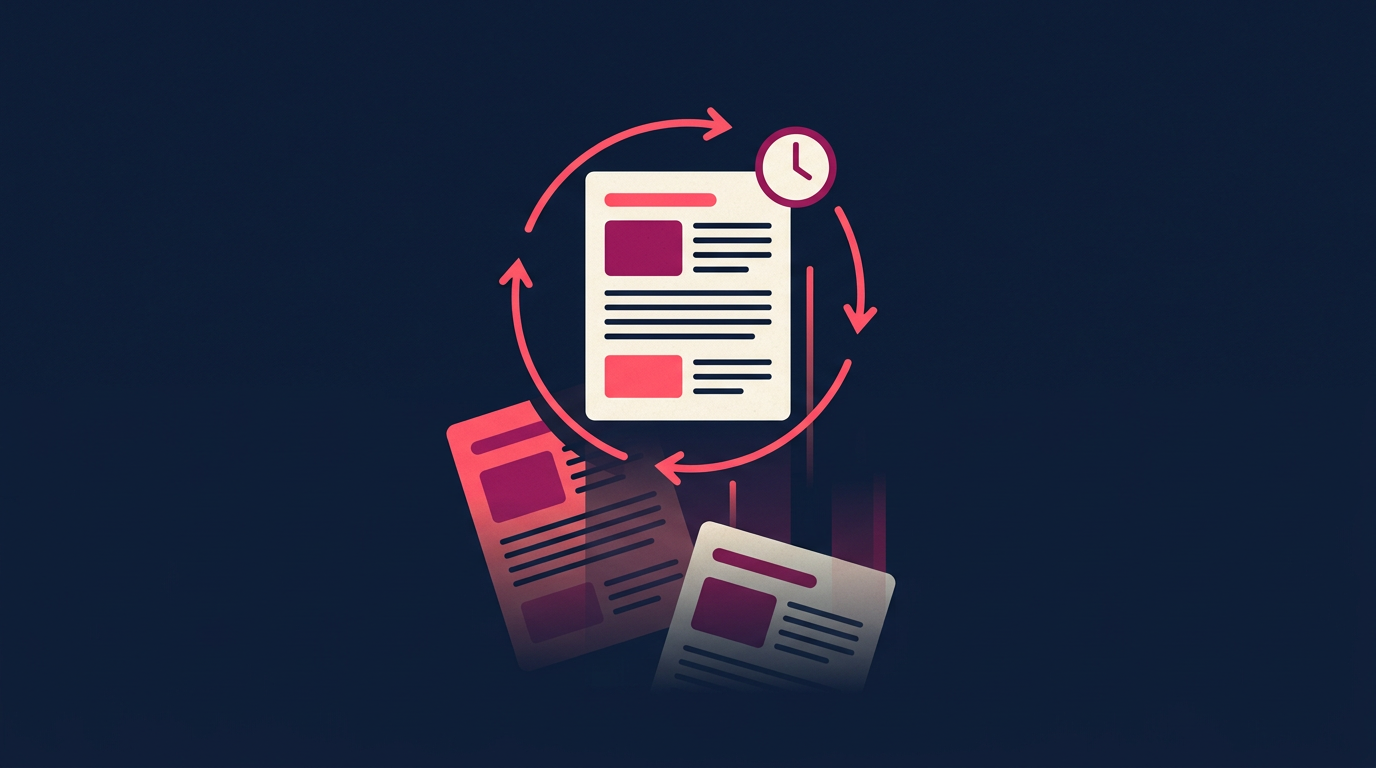
You have articles that rank, are well written… and AI still names others. Before blaming the content, look at the date.
In content marketing, winning today doesn't depend only on quality: it depends on the date. If you have articles that rank well but AI doesn't name them, the problem usually isn't the content, it's its freshness. Recency became one of the most concrete levers for getting cited by ChatGPT, Perplexity or Google's AI Overviews. And there's good news for your budget: refreshing an article you already have often pays off more than writing a new one.
In this guide we explain why this happens, how to choose what to update first, and what "refreshing" well means (spoiler: it's not just changing the date).
Why does AI cite recent content more?
Because, at equal quality, AI engines tend to prefer the new. GEO-sector reports from August 2026 point to content freshness or recency as a strong indicator of citation rate in AI engines. Translation: when two sources say the same thing with the same solidity, the one published (or updated) recently has more chance of ending up cited in the answer.
It makes sense if you think about how an AI assistant works. It doesn't return "the best document in history," it returns the best answer for today. And a useful answer today usually leans on current information: current prices, current versions, criteria that haven't gone stale.
This changes how you think about content. In classic SEO, an old article with good links could hold up for years. In the AI world, that same article can be left out of the conversation just from age signals. It's one of the SEO challenges of 2026 that is becoming tangible fastest.
Refresh an article or create a new one: which is better?
Generally, refresh. If you already have an article that gets impressions and covers a topic where there's news, updating it usually gives a higher and faster return than starting from scratch.
Think of it this way: a current article has already accumulated authority, links and a history on Google. When you refresh it, you capitalize on all of that and add the recency signal. When you create a new one, you start with a blank page: no history, no links, no position.
Creating new content still makes sense when:
- There's a topic or keyword you don't cover anywhere.
- The existing article is so outdated that rewriting it would, in practice, be a new article.
- You want to target a different search intent than your current articles.
For everything else, refresh first. It's the most efficient way to move the needle without inflating the editorial calendar, and it fits any content and SEO strategy that seeks results without duplicating production effort.
How to choose what to update first? A prioritization checklist
Start with the articles that combine three conditions at once. The practical criterion is simple: many impressions + old publication date + topic with recent news. When the three coincide, you have an ideal refresh candidate.
Use this checklist to order the queue:
- Does it have impression volume? Prioritize what people already search and see. Refreshing an article no one looks at changes nothing.
- Is the publication date old? The older it is, the bigger the recency gap you're leaving on the table.
- Was there news on the topic? If the subject changed (a tool, a metric, a practice), there's real material to update, not just makeup.
- Does the article already rank, but stalled? The ones near the top that can't quite climb usually respond quickly to a refresh.
- Is it an evergreen or pillar topic? Prioritize what sustains your long-term positioning over the circumstantial.
Quick rule: if an article marks yes on the first three, it goes to the very top. That intersection is the one that best combines impact and effort, and it's the base of a good strategy for updating content for AI.
What does "refreshing" an article well mean?
Refreshing for real means improving the content, not changing the date. Changing just the calendar date without touching the text is an empty signal: neither Google nor AI is fooled by that for long, and it adds no value to anyone.
A refresh that moves the needle includes things like:
- Updating data and examples: replace figures, versions or references that went stale with current ones.
- Adding what changed: add a section or paragraph with the topic's recent news.
- Reinforcing the direct answer: make sure each section opens by answering the question in a self-contained way, so AI can extract and cite the passage.
- Pruning the obsolete: remove what no longer applies instead of accumulating.
- Reviewing titles and headings: make sure they still reflect what your reader searches for today.
The logic of recency and AI citation rewards content that genuinely stays up to date, not the one that pretends to.
How do you measure if the refresh worked?
Look at two things: your classic visibility and your AI visibility. On the classic side, track the article's impressions, clicks and position before and after the change. Give it a few weeks: a refresh's effect isn't instant.
On the AI side, the game is different and traditional metrics aren't enough. It's worth understanding well what your panel tells you (and what it doesn't): an increase in citation on AI engines doesn't always show up as a jump in clicks, so you need to read the right signals.
Refreshing blog posts isn't a minor maintenance task: it's one of the most cost-effective ways to gain ground in AI answers with the content you already have.
Frequently asked questions
How often should I refresh a blog article? There's no magic number. Instead of a fixed calendar, use the priority criterion: review first the articles with many impressions, an old date and news on the topic. Those need a refresh; the rest can wait.
Is changing the publication date enough to get cited more by AI? No. Changing the date without improving the content is an empty, short-term signal. Recency counts when it comes with genuinely updated content: current data, incorporated news and clear answers.
Does refreshing content help both Google and AI? Yes, and that's its charm. A good refresh improves your quality and recency signals at once, so it usually benefits both your Google position and your citation rate on AI engines. It's a double return on the same effort.
Want to turn the content you already have into AI citations? Book a meeting with Seotronix.