 Español
 English
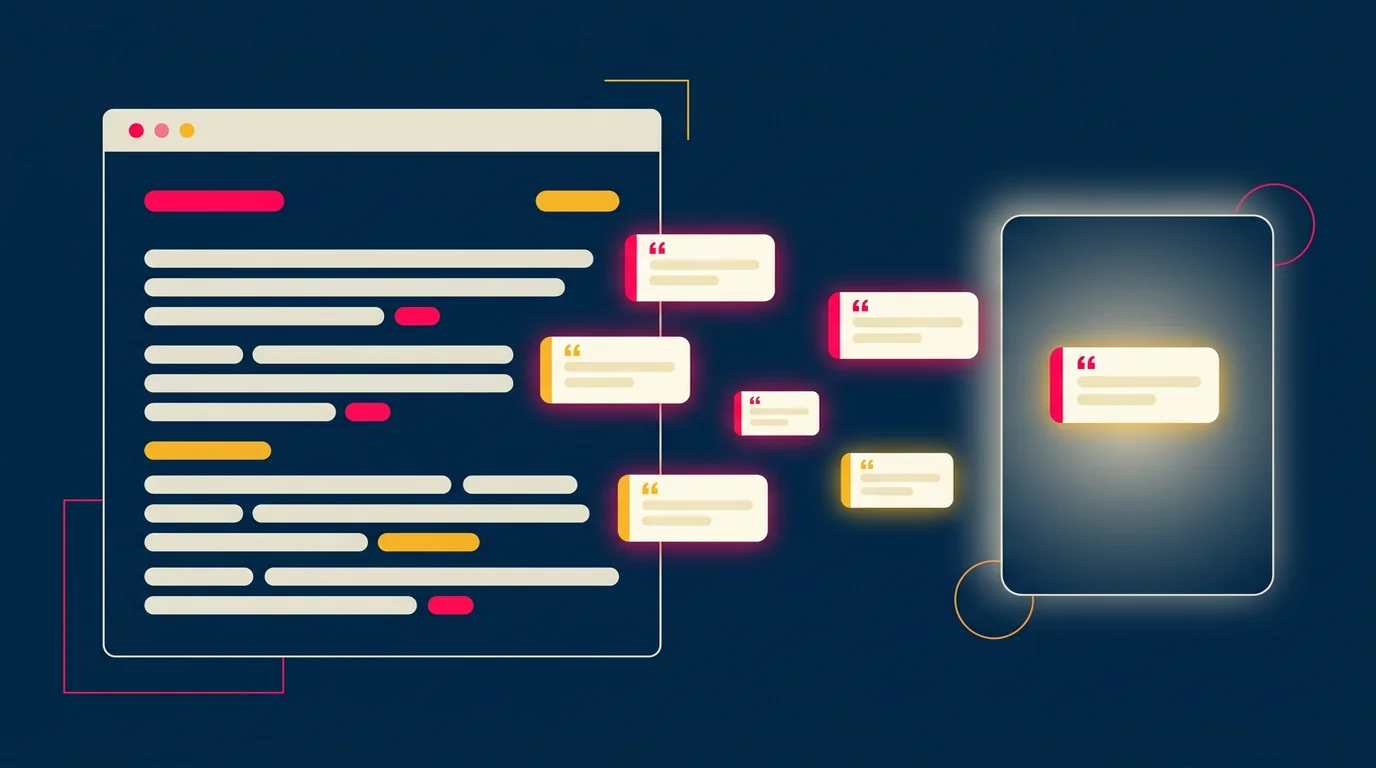
What makes ChatGPT, Perplexity, or an AI Overview quote you verbatim isn't adding FAQ schema, repeating your keyword, or writing longer. It's writing answer blocks: short, self-contained, data-backed responses placed at the top of each section, built so a generative engine can lift them and paste them without editing.
This isn't intuition. In 2026, Ahrefs tracked 1,885 pages that added structured data against a control group of 4,000 pages: the causal effect on AI citations was statistically indistinguishable from zero (ChatGPT +2.2%, AI Mode +2.4%) and slightly negative for AI Overviews (−4.6%) (Ahrefs). Meanwhile, the Princeton / IIT Delhi paper (KDD 2024) demonstrated that including citations, direct quotations from sources, and statistics—not markup—boosts visibility in generative engines by up to 40% (arXiv).
Here's what's happening underneath (passage ranking, snippet eligibility, how engines pick a source), the three myths still costing you citations, the step-by-step answer-block template with a before-and-after, and the multiplier no clean paragraph replaces: authority.
What is an answer block and why does it matter now?
An answer block is a 1–3 sentence response that stands on its own (readable without the preceding context), carries a data point or source inside it, and sits at the top of the section it belongs to. It's the unit a generative engine can lift without rewriting.
Why it matters now, measured:
- In 2026, 68.01% of Google searches ended without a click to any site (SparkToro, using Similarweb clickstream data). If the answer is served on the results page, the game shifts from "ranking first" to "being the source quoted inside the answer."
- With an AI summary present, users click any traditional link in only 8% of visits (vs 15% without a summary). Inside the AI summary itself, they click a cited source in just 1% of visits (Pew Research Center).
Clicks are dropping; being mentioned inside the generated answer becomes the asset. To get mentioned, your content has to be written in chunks that can be cut and pasted.
What AI engines actually copy (and what they don't): the official mechanics
No magic. A documented retrieval-and-extraction system, confirmed by independent research.
1. Engines retrieve pages that are already indexed and snippet-eligible. Google is explicit in its official docs: to appear as a supporting link in AI Overviews or AI Mode, "a page must be indexed and eligible to be shown in Google Search with a snippet" (Google Search Central). No additional technical requirements. If you block snippets with nosnippet or max-snippet:0, you remove yourself from the race.
2. Google ranks passages, not just whole pages. The official Passage Ranking definition: "an AI system we use to identify individual sections or 'passages' of a web page to better understand how relevant a page is to a search" (Google Search Central). A well-delimited passage can get extracted even if the rest of the page is about something else.
3. Generative engines (ChatGPT, Perplexity, AIO) do "query fan-out": they fire multiple related sub-queries, synthesize a response, and cite several sources. The target stops being "rank a link" and becomes "be the passage that gets quoted." The GEO paper models visibility as a combination of citation length, position within the answer, and the style used to embed the source—not just whether you appear.
4. What moves the needle (and what doesn't), with data. The Princeton / IIT paper tested several tactics across 10,000 queries on a real generative engine: adding citations, direct quotations, and statistics boosted visibility by over 40% across various queries, with up to +37% measured on Perplexity.ai. Keyword stuffing didn't work—and in several cases it made results worse. Jakob Nielsen, in his newsletter, reaches the same conclusion, drawing on an analysis of ~30 million AI citations (by Profound): "LLMs don't cite SEO spam" (Jakob Nielsen).
Practical translation: engines copy the passage that already carries its own proof (data + source + self-contained wording). They don't look for the one that "deserves" the citation by abstract authority; they look for the one they can paste without editing.
Three myths still costing you citations
Myth 1 — "Add FAQ schema and AI will quote you."
Two documented problems. First: Google deprecated FAQ rich results in August 2023; today they "only show for well-known, authoritative government and health sites; they will no longer appear for everyone else on a regular basis" (Google Search Central Blog). The visible SERP widget is gone. Second: Ahrefs' causal study on 1,885 pages that added schema found no uplift in AI citations. On AI Overviews, the effect was negative (−4.6%).
Honest nuance: schema is still useful for disambiguating entity (Article, Organization), for Merchant Center and Google Business Profile, and for rich results where they still exist (product, recipe, how-to). What it won't do is "activate" a citation.
Myth 2 — "Longer = more citations."
AI engines extract chunks—definitions, lists, comparisons—not whole documents. In geol.ai's content-structure scoring, a "narrative essay" scores 7/20 on citability criteria; a "definition + table + short sections" format scores 18/20 (geol.ai). The GEO paper agrees: what moves visibility isn't volume, it's density of citable value.
Myth 3 — "Keyword density: I repeat the keyword so AI picks me."
This is the one tactic the GEO paper tested explicitly and discarded: "in some cases it led to worse results than doing nothing" (WPShout, summarizing the paper). Generative engines synthesize meaning; they don't count repetitions. 2000s-era SEO doesn't recycle into the answer era.
The answer-block pattern, step by step
Eight steps. The first six are writing; the seventh is infrastructure; the eighth is the off-site multiplier.
1. Question-shaped (or intent-shaped) headers. Engines rank passages against the user's query. An H2 like "What is answer engine optimization?" matches directly; one like "On the new paradigm" doesn't.
2. Direct answer within the first 150–250 words of the section. The first sentence after the header must answer the question completely. Nothing of the "before answering, let's set some context" kind.
3. Self-contained 1–2 sentence definitions. Format: "X is a Y that does Z." Entities named with their canonical name, not pronouns. If your paragraph requires the reader to remember who "this kind of content" is, AI won't lift it.
4. One claim per paragraph. Kill the pronouns. Replace "this", "that", "as we saw" with the named entity. The model needs the passage to stand on its own because it will extract it without the surrounding context.
5. Citable data with source + statistics. The GEO paper shows this is what moves the needle most (+40% with citations, quotations, and statistics combined). State the number, the source, and the year. Link to the primary source. "Over 60% of searches" isn't data; "68.01% in 2026 according to SparkToro using Similarweb clickstream data" is.
6. Comparison tables and lists where they fit. At least one structured table or list per piece. Comparisons and lists are among the formats LLMs reuse most; long narrative blocks are among the least.
7. Schema as infrastructure (not as a hook). Add Article, Organization, and Person to disambiguate entity and authorship; keep the page, the schema, your Google Business Profile / Merchant Center, and third-party mentions coherent. But expect zero "citation activation" from markup itself. Search Engine Journal puts it bluntly: "schema markup won't make AI systems cite you directly" (SEJ).
8. Build off-site authority: the multiplier. Next section.
Before / after on the same paragraph
Before (traditional narrative paragraph, not extractable):
In today's digital landscape, with the rise of artificial intelligence engines, companies face a new paradigm. As we saw earlier, traditional SEO is no longer enough; we need to think about new ways to make our content visible. This means rethinking how we write and structure information so these tools can understand it.
Problems: doesn't answer a specific question, uses "this" and "as we saw", no data, no source, doesn't stand alone. Pasted into a ChatGPT answer, it adds no information.
After (rewritten as an answer block):
What is answer engine optimization?
Answer engine optimization (AEO) is the practice of writing content in self-contained passages that ChatGPT, Perplexity, and AI Overviews can extract and quote verbatim inside their responses. Unlike traditional SEO, whose goal was to rank the page to win the click, AEO aims for a passage to win the citation inside the synthesized answer (operational definition in line with the Princeton / IIT GEO paper, KDD 2024).
What changed: question in the header, self-contained definition in one sentence, full entity name, concrete comparison with classic SEO, linked source. This passage can be dropped into an AI response without a single edit.
The clean-paragraph trap: why authority is the real multiplier
Answer blocks make you extractable. Authority makes you eligible. These are two separate problems.
Ahrefs' study on 75,000 brands measured which signals correlate most strongly with being cited in AI Overviews: the strongest was web brand mentions (0.664), followed by brand anchor text (0.527)—both well above backlink count (0.218) (Ahrefs). It's correlation, not causation—Ahrefs says so explicitly—but the signal is consistent: AI engines pick who to cite partly based on what gets said about the brand off the page.
For a business owner, this means: if you only invest in rewriting your blog in answer blocks and skip building off-site visibility and authority (PR, mentions, community participation, YouTube, industry podcasts), you end up with the cleanest-written content in your category and the AI citing your competitor anyway. Answer blocks without authority = necessary but not sufficient.
The reverse is also true: authority without answer blocks loses, too. If the AI can't lift a passage from you without rewriting it, it picks someone else—even if it knows you.
How to measure if it's working (without vanity metrics)
Three real signals. Not "rankings" or "keywords ranked."
- Search Console impressions on informational queries with AI Overview active. The earliest signal. If your content starts appearing as a supporting link in AIO, impressions move before clicks do.
- Brand mentions and citations in AI responses. Monitoring tools (Ahrefs Brand Radar, Profound, Peec AI, and the GEO dashboards that showed up in 2026) report whether ChatGPT, Perplexity, and AIO started citing your brand across a fixed prompt set. This is measured by brand, not by page.
- Share of citation and share of recommendation on a fixed prompt set. Define 20–50 prompts central to your business, run them weekly, and track what percentage cites you, what percentage recommends you, and your trend vs. a frozen competitor set. This replaces "ranking by keyword" for the answer era.
Plus two technical checks: confirm your pages are snippet-eligible (no global nosnippet) and that your direct answer lives within the first 250 words; and keep your content current, because generative engines favor recently refreshed sources. If you don't, you're not even in the game.
How we think about this at Seotronix (agency perspective)
Proposals that end up without citations, even when the content is correct, repeat the same three patterns. It works as a decision frame to qualify whether a paragraph of yours is actually an answer block:
Three questions to qualify a paragraph as an answer block:
- Does it stand alone if you cut it out? Read it outside the context. If it uses "this", "that", "as we saw", or depends on an earlier paragraph, it fails.
- Does it answer the header's question in the first sentence? Not the second or the third. The first.
- Does it carry a number, a stat, or a linked source inside it? Without data, it's opinion. AI prefers passages that carry their own proof.
If any of the three is "no", rewrite it. If the three are "yes", you have an answer block.
Seven signs a passage is not citable (if any of these show up, the paragraph won't get lifted):
- Opens with "In today's digital landscape…" or any generic opener.
- Uses "this" or "that" as the main subject.
- The answer arrives after the fourth or fifth line.
- Doesn't name the entity by its canonical name (uses "the tool", "the engine").
- Carries no data and no linked source.
- Repeats the keyword more than two or three times per 100 words.
- Closes with a cliché ("the key is…", "the future of SEO…").
We tested it on Google itself. On October 11, 2026, we took the AI Overview Google synthesizes for "answer engine optimization" and for "how to get cited by chatgpt" and ran the three questions above against it. Both summaries are written as answer blocks—direct definition up top, one claim per bullet, named entities, statistics inside—and they independently recommend exactly what the Princeton paper measured: the answer in the first 20–60 words, paragraphs of 2 to 4 sentences, 3 to 5 statistics per 1,000 words, and named entities instead of generalizations. The only passages that fail the three questions are the conversational closers ("if you'd like, tell me your industry…"). Put simply: when the engine shows you the pattern it rewards, the move is to copy it.
Operational rule: the proprietary insight of every piece (data, test, or framework) should be written as an answer block itself. If your differentiator can't be quoted verbatim, it's not a differentiator—it's filler.
To see how AI decides who to show first, check whether your site appears in ChatGPT.
Frequently asked questions
What is answer engine optimization (AEO)?
AEO is the practice of writing content in self-contained passages that ChatGPT, Perplexity, AI Overviews, and other generative engines can extract and quote verbatim inside their responses. Unlike traditional SEO, which aimed to rank the page to win the click, AEO aims for a passage to win the citation inside the synthesized answer.
Does adding FAQ schema make AI cite me?
No. Google deprecated FAQ rich results in August 2023 (they only show for well-known government and health sites now). And Ahrefs' causal study on 1,885 pages that added schema between August 2025 and March 2026 found no uplift in AI citations: ChatGPT +2.2%, AI Mode +2.4%, AI Overviews −4.6%. Schema helps disambiguate entity—it doesn't force a citation.
What actually works to get cited by AI?
What the GEO paper measured (Princeton / IIT Delhi, KDD 2024): adding citations, direct quotations, and statistics boosts visibility in generative engines by over 40% across various queries, validated at up to +37% on Perplexity.ai. Writing self-contained passages with the direct answer in the first 150–250 words is the baseline.
Is this the same as optimizing for featured snippets?
It looks similar (direct answer, question-shaped headers) but it isn't. A featured snippet wins one box with one URL. Generative engines synthesize an answer citing multiple sources, and they decide who gets in also based on authority and brand mentions—off-site signals. Answer blocks are the necessary condition; authority is the multiplier.
How do I measure if I'm winning AI citations?
Three signals: (1) Search Console impressions on queries with AI Overviews active; (2) brand mentions in AI responses, tracked with a monitoring tool (Ahrefs Brand Radar, Profound, Peec AI); (3) share of citation on a fixed prompt set, run weekly against a frozen competitor set. "Rankings" stop being the unit of measurement.